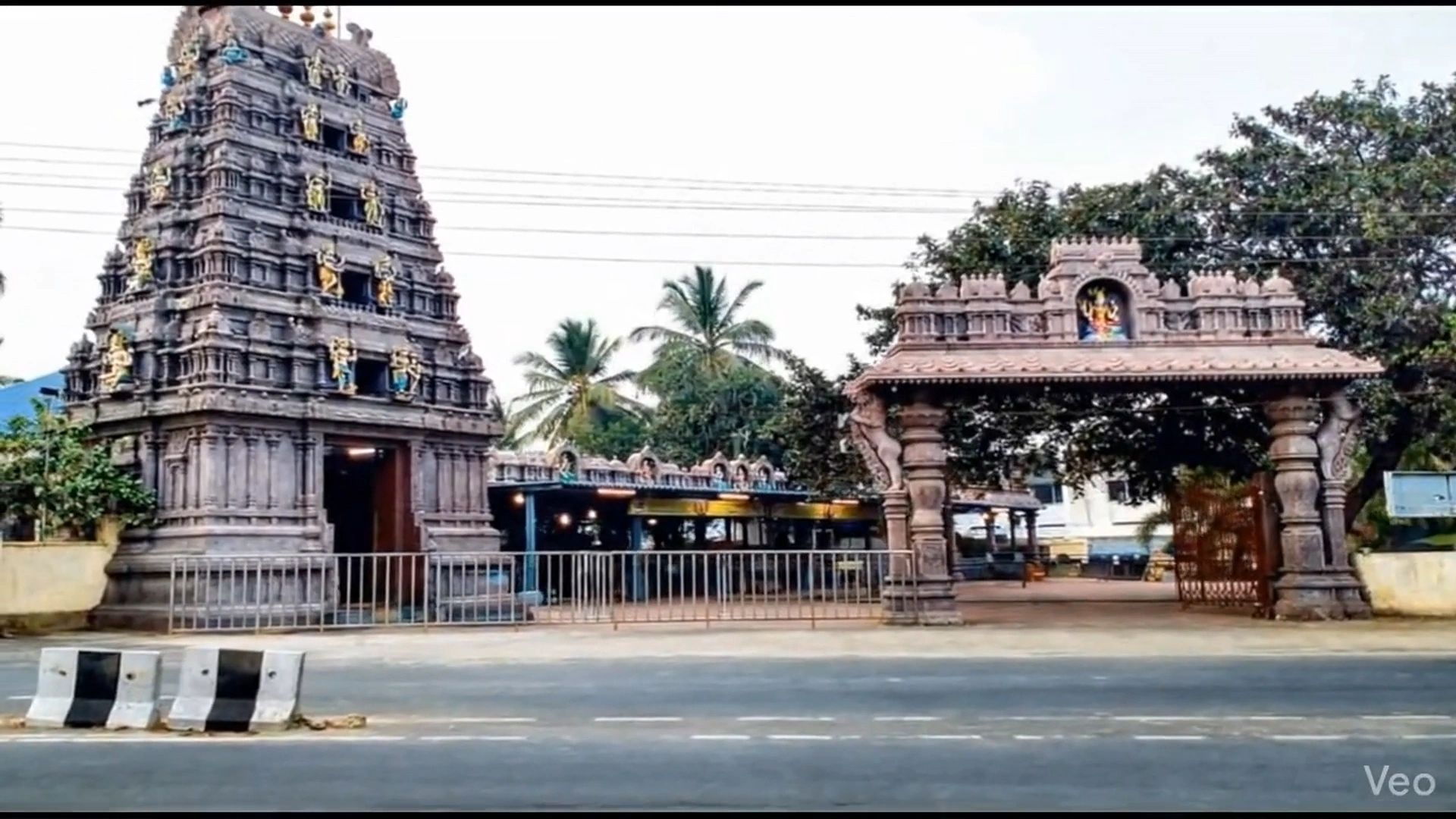
Sri Sri Sri Karakachettu Polamamba Ammavaru is venerated as a self-manifested deity, believed to have emerged before the 16th century, possessing a rich and unique temple history.
During the time when the French and Portuguese were involved in maritime trade along the eastern coast of India, a group of fishermen from Pedajalari Peta ventured into the sea for fishing. While casting their nets, they miraculously uncovered the sacred idol of the Goddess in the waters. The fishermen devotedly worshipped the idol for several days.
One night, the Goddess appeared in their dreams and instructed them to hand over her idol to the Maddi clan of Pedda Waltair. Following her divine command, they entrusted the idol to the Maddi lineage, who continued to revere her. After some time, the Goddess reappeared in their dreams, directing them to consecrate her beneath a Karaka tree, located near cashew (Jeedi) trees. Following her instructions, the idol was installed under the Karaka Chettu, and from that moment on, she became known as Karakachettu Polamamba Ammavaru.
The Goddess is honored as the Gramadevatha (village deity) of fourteen coastal villages along the seashore. Each year, a grand and magnificent Jatara is celebrated in the month of Chaitra with immense devotion and enthusiasm. On the festival day, devotees traditionally throw cashew fruits (Jeedipallu) onto the temple roof as an offering. Because of this unique tradition, she is also fondly referred to as Jeedipalla Ammavaru.
The idol of the Goddess features distinctive divine elements. She is depicted with three serpents adorning her head. In her right hands, she holds a lotus and a sword (Khadgam), while in her left hands, she carries a serpent and a kumkuma bharini. Since she was discovered in the sea, she is worshipped as Samudra Devata (Sea Goddess). As she bears serpents on her head, she is also revered as Sarpa Devata (Serpent Goddess).
On the right side of Polamamba Ammavaru stands the idol of Kunchamamba Ammavaru, and on her left is Neelamamba Ammavaru. Within the temple premises, sub-shrines are dedicated to Nesthalamma, Bangaramma, Dandu Maremma, Kanaka Durgamma, Pidugulamma, Sattemma, Mutyalamma, and Pothuraju.
The temple complex also features a Gosala (cow shelter), Yaga Sala (sacrificial hall), and Kalyana Mandapam (marriage hall), making it a spiritually vibrant and culturally significant sacred center for devotees.